Understanding Sheet Musick: More Time Signatures

Welcome to another video/posting on understanding sheet musick. Sheet musick is given so that a whole congregation can have one standard for a melody. So that they may all sing with one voice.
In this video I will discussing:
- The 6/8 time signature
- The 2/2 time signature
- Ties
- Meter
- Tune name
To understand the different time signatures you need to start with 4/4.
If you remember from the last posting on understanding sheet musick, 4/4 time means there are four beats in a measure (top 4) and the quarter note gets the beat (bottom 4).
Only concentrate on the bottom note of the time signature for singing hymns. How many beats are in a measure is not as important to the singer compared to which note gets the beat.
Now comes in 6/8 time and 2/2 time.
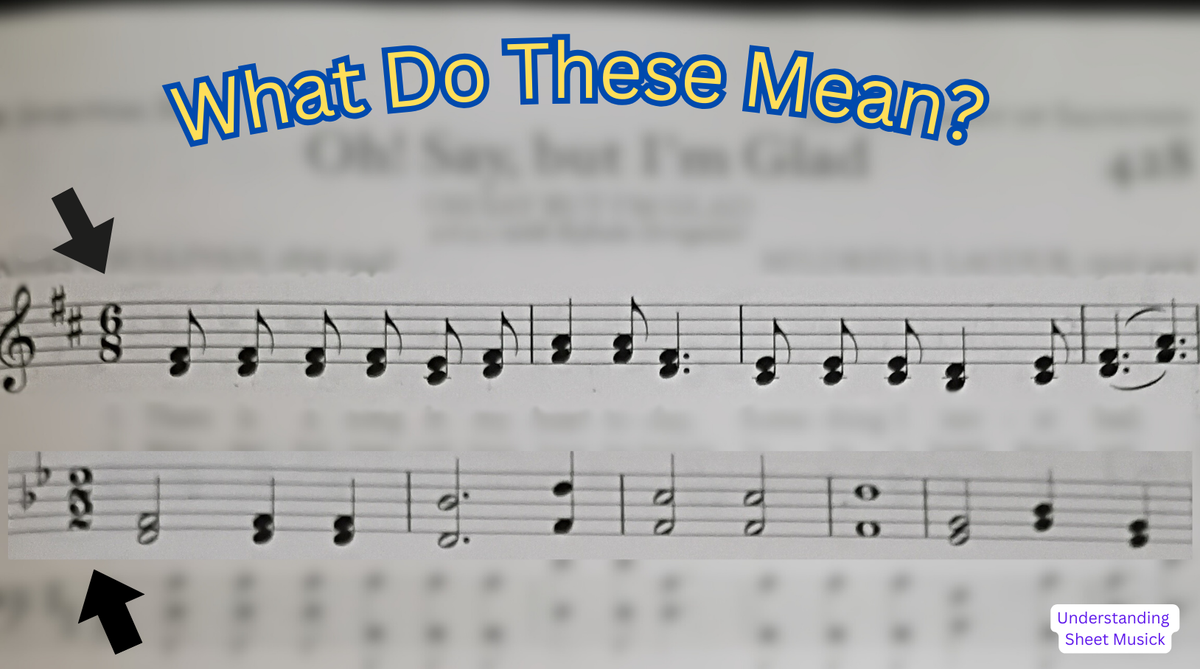
In 6/8 time the eighth note gets the beat. You can remember this easily by the name of the note - "eighth". To understand how many beats the rest of the notes get, think in multiplication. If you multiply four by two you get eight. (4 x 2=8)
So, every note duration is going to be doubled in 6/8 time as compared to 4/4 time.
- The eighth note will get 1 beat. (1/2 x 2 = 1)
- The quarter note will get two beats (1 x 2 = 2),
- The half note will get four beats. (2 x 2 = 4)
- A dotted half note will get six beats (3 x 2 = 6).
Now with 2/2 time. Concentrate on the bottom number of the time signature (2).
The half note will get the beat in this time signature. This time signature will divide all note durations in half as compared to 4/4 time. (4/2 = 2)
The quarter note will get 1/2 beat (1 divided by 2 = 1/2)
The half note will get one beat (2 divided by 2 = 1)
The whole note will get two beats. (4 divided by 2 = 2)
Don't be afraid of the different time signatures. These are the only three numbers you need to know (2,4,8).
These numbers are simply telling you which note will get the beat. And remember, that every syllable has a note. The note is telling you how long to hold the syllable.
Take the time to grab your own hymnal and look at the different time signatures in your favorite hymns.
My hope with these videos is that the viewer may learn how to read sheet musick, so they may follow the melody well. Also remember that singing unto the Lord Jesus Christ is more important than singing the melody as written.
Psalms 66:1 Make a joyful noise unto God, all ye lands:
(This information is explained while looking at a hymn in the video below)